The MUHBA: Barcelona’s Storyteller
MUHBA stands for Museu d’Història de Barcelona (the Barcelona City History Museum). Rather than being just a single building, it is a network of sites and historical landmarks spread throughout the city. Instead of merely displaying objects in glass cases, the MUHBA treats the city itself as its largest exhibit. The MUHBA Turó de la Rovira is not a traditional gallery, but a “place of memory.” It is an open-air museum at the Bunkers del Carmel that uses the power of the landscape and the ruins themselves to tell its story. Here, you experience history in its full force, set against the spectacular views that once justified the site’s strategic value.
What is the difference between the Bunkers del Carmel and MUHBA Turó de la Rovira?
- MUHBA Turó de la Rovira: This is the institutional body. It represents the museum’s management and the city’s conservation efforts.
- Turó de la Rovira: This is simply the geographical name of the 262-meter-high hill.
- Bunkers del Carmel: This is the historical nickname and the most popular colloquial term for the site. It specifically refers to the ruins of the anti-aircraft battery from the Spanish Civil War (1937) located at the summit.
The Mission of MUHBA Turó de la Rovira
The primary mission of the Barcelona City History Museum (MUHBA) at Turó de la Rovira is the protection and interpretation of 20th-century heritage. This hill represents a convergence of the tragedy of the Spanish Civil War and the social struggles of the post-war era. The MUHBA has taken on the responsibility of preserving the military ruins and documenting the remains of the shanty town, ensuring that this difficult chapter of the city’s history does not fade into oblivion. Its goal is to make certain that the stories of the anti-aircraft battery and the Barri dels Canons continue to be told.
What is there to see at MUHBA Turó de la Rovira?

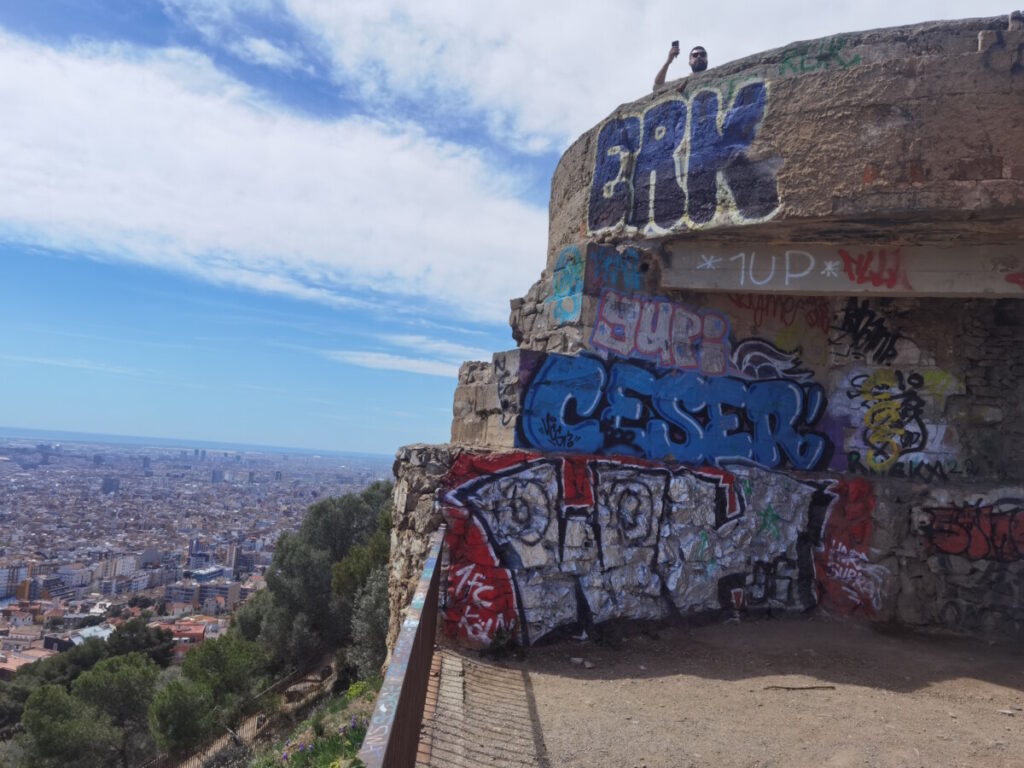
When you visit MUHBA Turó de la Rovira, the museum isn’t just “indoors”—the whole site is a discovery trail. The most famous parts are the massive concrete platforms. These circular bases held the 105 mm cannons back in 1937, and today they are the best spots for photos. The MUHBA has set up signs here that explain how the battery worked and even show the flight paths of the bombers that the soldiers were trying to hit.
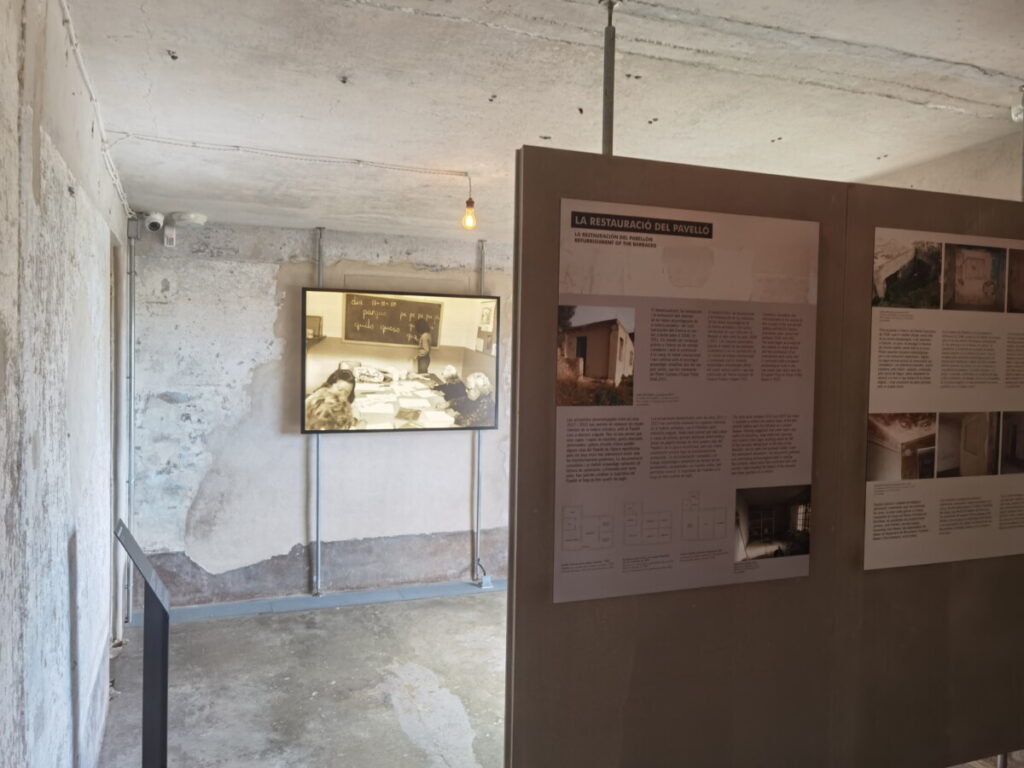
You can also explore the Command Post (Puesto de Mando), the heart of the defense system. It’s filled with old photos and documents that show what it was like to be stationed here during the war.
But it’s not all about the military. The museum also highlights the Barri dels Canons, the shanty town that existed here for decades. Even though the huts are gone, you can still see the ruins of walls and old water tanks. Combined with stories and pictures of the families who lived here, it gives you a real sense of the tough living conditions during the Franco years. It’s a powerful mix of war history and human stories.e Franco era and the decades of difficult living conditions tangible for every visitor. The exhibition masterfully combines military and social history in one space.
More Than Just a Pretty View: History from Above

At Turó de la Rovira, the view isn’t just for photos—it’s part of the history lesson. When you stand at the top and look over the city, you immediately get the military significance of the spot. It’s easy to see why the cannons were placed here: there’s a clear line of sight in every direction, making it the perfect defensive position. It really brings the logic of wartime strategy to life.
But there’s another side to the view: urban planning. Looking down is like looking at a giant 3D map of Barcelona’s history. You can see the contrast between the narrow streets of the Old Town and the famous grid system of Eixample, stretching out toward the hills. The MUHBA uses this vantage point to show how the city grew, where it was planned, and where it just expanded naturally. It’s the ultimate way to understand the metropolis of Barcelona.
What the MUHBA Actually Does
The main objective of the MUHBA is to tell the complete history of Barcelona, from its Roman origins to the present day. It essentially acts as an on-site archivist, ensuring that significant historical sites and ruins do not disappear or fall into oblivion. The museum ensures that we can have an authentic experience at the original locations, gaining insight into how people lived and what they endured. What makes MUHBA Turó de la Rovira so special is that it isn’t a traditional museum with a ticket office; instead, visitors literally walk through history, experiencing the narrative as they explore the site.
Related Links:
- all the information about the Bunkers del Carmel
- this is the district of El Carmel
- the well-known Turó de la Rovira
- how to get there
- enjoy the best sunset in Barcelona